
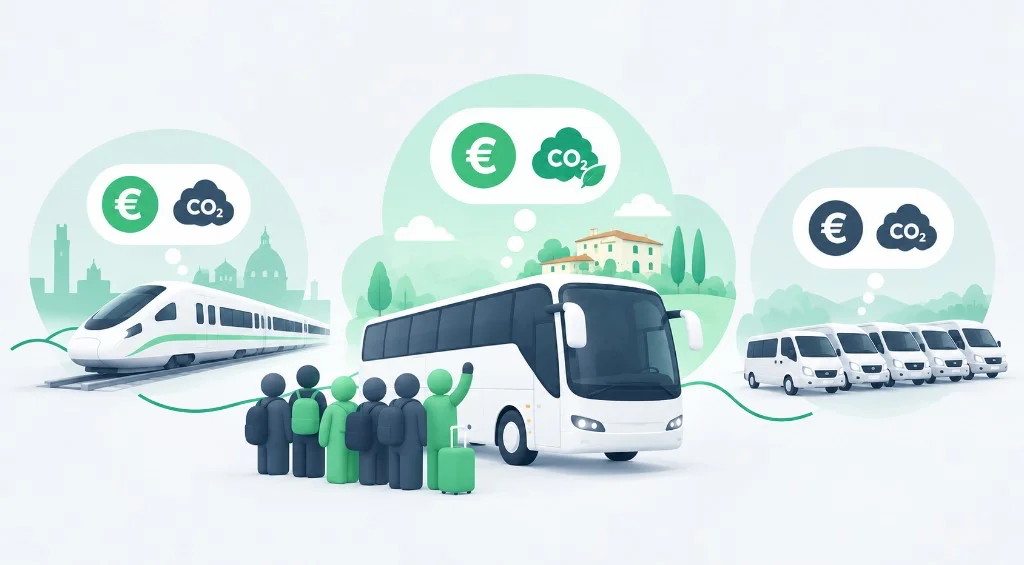
The coach wins almost every time. But not for the reason you think.
When a group needs to travel, most organisers open three browser tabs: train tickets, van rental, coach hire. Then they compare the price per seat.
That comparison is almost always misleading.
The coach does tend to come out on top. But not because buses are cheap, and not because they're green by nature. It wins for a structural reason that most cost comparisons miss completely.
The scenario: 45 people, two days, one offsite
Let's make it concrete. A company in Milan is taking 45 employees to a two-day retreat at a villa in the Tuscan countryside, about 20 km outside Florence.
It's a very typical request. It could just as easily be a school trip, a sports team or a wedding party.
Train vs coach for groups: cheap on paper, expensive at both ends
The Milan–Florence high-speed train takes under two hours. It's fast, comfortable and electric. On paper, it looks unbeatable.
Here's what the full trip actually involves:
- Tickets: €60–90 per person return, depending on how early you book and how flexible the fare is. For 45 people, that's €2,700–4,050.
- Getting to the station: 45 people with luggage, crossing Milan at rush hour to reach Centrale. Someone will be late. The train won't wait.
- The last mile: Florence station is not the villa. You still need to move 45 people and their bags 20 km into the countryside. That means a coach or several vans at the destination, twice. Budget €700–1,000.
Total: roughly €3,500–5,000.
The pattern is simple. The train is excellent between two stations. But groups rarely travel between two stations. They travel from an office, a school or a hotel to a venue. Every extra leg adds cost, coordination and risk.
Coach hire vs minibus: the hidden cost of six vehicles
The second instinct is to rent vans. A 9-seat van can be driven with a standard car licence, and rental looks affordable.
But 45 people don't fit in one van. They fit in six.
- Rental: €160–220 per van per day. Six vans for two days: €1,900–2,650.
- Fuel: around 700 km per van including local moves. Roughly €700–750 in total.
- Motorway tolls: six vehicles, each paying both ways. Around €300.
- Parking: six spaces at the villa, in Florence, wherever you stop. €150+.
Total: roughly €3,100–3,850.
And that's before the costs that don't show up on an invoice:
- Six of your people are now drivers. They're not resting, not networking, not having a glass of wine at dinner.
- Six insurance excesses. One scraped mirror in a narrow Tuscan lane and the budget moves.
- Six vehicles to coordinate. Convoys split up. Someone misses the exit. Arrival times drift by 40 minutes.
If you hire vans with professional drivers instead, the problem changes but the maths gets worse: typically €4,500–6,000 for six vehicles over two days.
Group transport cost: the coach
A 54-seat coach with a professional driver picks the group up outside the office and drops them at the villa door. It stays available for local transfers and brings everyone back.
- Coach and driver, two days: fuel, tolls and driver accommodation included. €2,000–2,600.
- Access permits and parking: depending on the route and any city stops. €100–300.
Total: roughly €2,100–2,900.
No station transfers. No second set of vehicles at the destination. No colleagues behind the wheel.
Sustainable group travel: occupancy is everything
Cost is only half the argument. More and more companies and schools need to justify travel choices on emissions too.
Let's be honest from the start: station to station, electric rail is usually the lowest-emission option. We won't argue with that.
But groups don't travel station to station. So let's do the maths on what actually moves.
A diesel engine emits roughly 2.65 kg of CO₂ per litre burned. From there:
- A coach uses around 30 litres per 100 km. With 45 passengers, that's about 18 g of CO₂ per passenger-km.
- A 9-seat van uses around 10 litres per 100 km. With a realistic 7–8 people on board, that's about 35 g per passenger-km, roughly double.
- The train starts very low, but the first and last miles add emissions: taxis, transfers, and in our scenario an extra vehicle at destination running twice.
Now run the coach numbers again with only 15 people on board. Emissions per passenger triple to about 53 g.
That's the key point.
A coach isn't green because it's a coach. It's green because it's full.
The real reason the coach wins
Most people assume the coach wins because buses are a cheap way to travel. That's not quite it.
The coach wins because it's the only option that moves the group as a single unit, door to door.
Look at what drives cost and emissions in every scenario above:
- The number of vehicles. Six vans means six rentals, six tanks, six tolls, six parking spaces, six engines.
- The number of handoffs. Every change of mode adds a transfer, a waiting time, and a chance for something to go wrong.
Neither of those scales with how many people you have. They scale with how fragmented the journey is.
A coach absorbs the whole group into one vehicle and one journey. Costs are shared across 45 seats. Emissions are shared across 45 passengers. Coordination drops to a single pickup time.
That's also why a half-empty coach is a bad deal, both financially and environmentally. The advantage only exists when the vehicle matches the group.
Next steps
The ticket-price comparison survives because it's the only number that's easy to find. Train fares and van rentals are a few clicks away. Coach prices, in most of Europe, still mean emails, phone calls and days of waiting.
So organisers compare what they can see, and often pick the option that looks cheapest rather than the one that actually is.
That's exactly the gap Quotabus closes. A coach quote should be as easy to get as a train ticket. Once it is, the most efficient way to move a group, both financially and environmentally, becomes the obvious choice.
On Quotabus, you describe your itinerary once and our AI-powered portal prices it for you. You get an offer straight away, or within 48 hours for more complex trips, backed by our network of bus operators across Italy and Europe.
From there, one team takes care of everything: booking, operator coordination and 24/7 support until your group is back home. If plans change, you can update the itinerary yourself. If something goes wrong on the day, a backup operator is ready to step in.
Planning a school trip, a company offsite or a group tour? Try the Quotabus portal and get your quote in minutes, or write to us at noleggio@quotabus.com. We'll help you find the right vehicle for your group, not just the cheapest ticket.